The Key in the Candlestick Box
Chapter 1The Little Brass Key
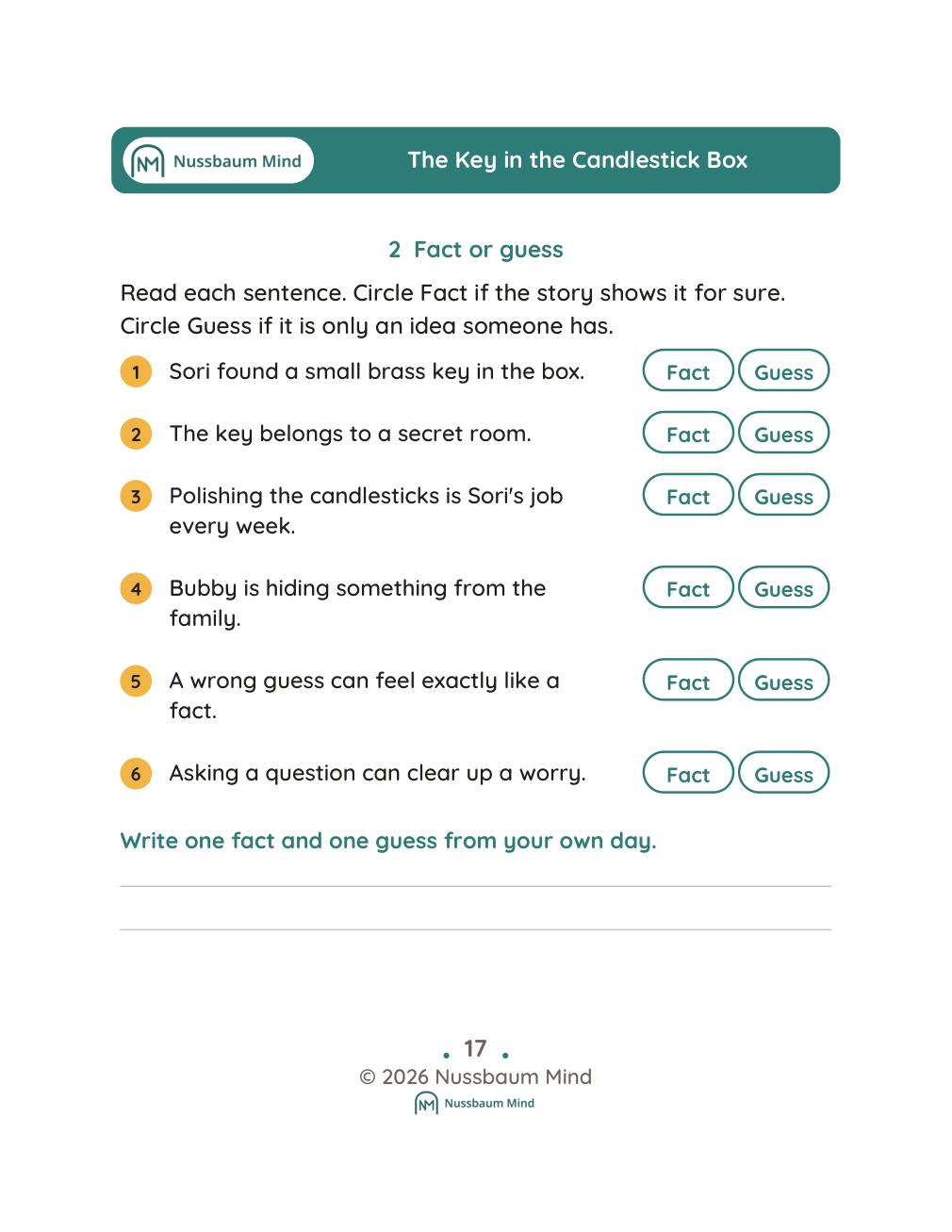
On Friday afternoon, Sori Klein sat at Bubby's kitchen table with a soft cloth in one hand and a silver candlestick in the other. Polishing the candlesticks was her job every week. She liked it. First the silver was dull and gray, and then, rub by rub, it began to shine.
"Don't forget the wooden box," Bubby called from the stove. "It needs a wipe too."
The candlestick box was old and dark, with a lid that squeaked. Bubby kept the extra candles inside, along with a box of matches and a folded square of felt. Sori lifted the felt to wipe underneath. Something small slid across the wood and clicked against the side.
It was a key.
It was tiny and brass, no longer than her finger, and tied to a loop of faded blue ribbon. Taped to the bottom of the box, where the felt had hidden it, was a little note. The paper was soft with age. Sori read it twice.
"For when you are ready. The blue door. Do not hurry. Ask first."
Sori's heart began to thump. She looked at the stove. Bubby was stirring the soup, humming to herself, with her back turned.
A key. A note. A blue door. This was not a normal Friday.
Sori slipped the key into her pocket. She did not decide to hide it. It just happened, the way a hand goes up when a question comes. Before candle-lighting she zipped the key into her overnight bag, since she would not carry it on Shabbos. Then she finished the wooden box, put the felt back, and carried the shining candlesticks to the dining room table. Her mind was racing the whole time.
What was the key for? And why had Bubby hidden it?
Chapter 2The First Guess
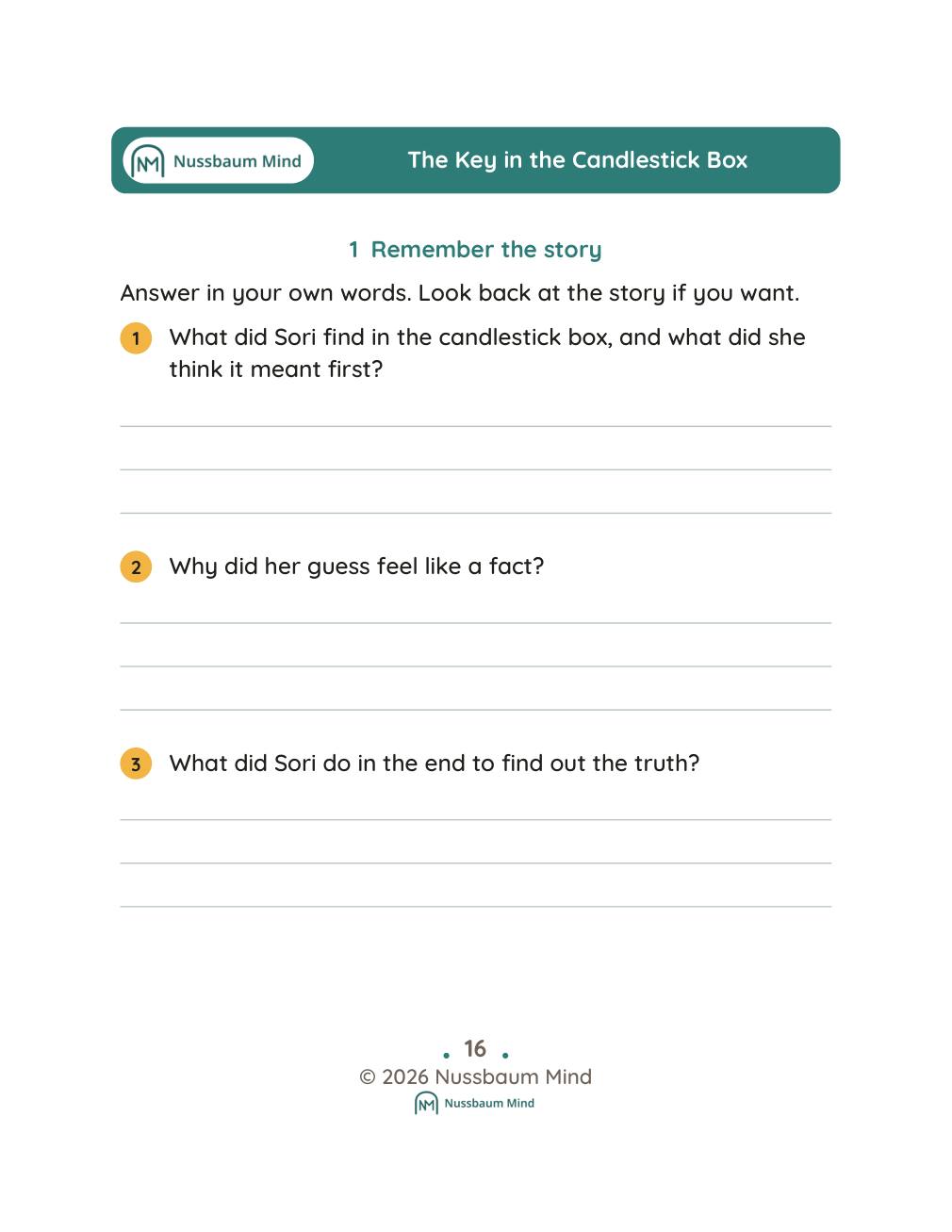
By the time the candles were lit, Sori had made up her mind. The key was for a treasure.
It made perfect sense. Bubby had grown up far away, in a country Sori could not even pronounce. Bubby had come to America with one suitcase. A grandmother like that could easily own a secret trunk filled with old coins or a family necklace. The blue door must be where it was kept.
On Shabbos morning, after davening, Sori walked home beside Bubby and looked at every door on the street. There was a red one, a green one, and a brown one with a brass knocker. There was no blue one.
"You're very quiet, Sorele," said Bubby.
"I'm thinking," said Sori. It was true. She was thinking so hard that her tights felt scratchy and her braid felt heavy.
That afternoon, Sori's cousin Malky came over. Malky was twelve and always sure of herself. Sori could not keep it in any longer. She pulled Malky behind the couch and whispered the whole thing, even though the key itself was still zipped in her bag.
Malky's eyes grew big. "A key and a note that says don't hurry? Sori. Your Bubby is hiding something."
"A treasure," said Sori.
"Or a secret," Malky said slowly. "A big one. People don't tape notes under boxes about happy things."
A cold feeling crept into Sori's tummy. She had not thought of that. She looked across the room at Bubby, who sat in her armchair in her soft gray tichel, a siddur on her lap. Her eyes were closed, and her face looked tired.
What if the secret was a sad one? What if Bubby had lost something, or someone, long ago? What if the blue door led to something that hurt?
Sori did not sleep well that night. She lay in bed with the guess growing bigger and bigger in her head. By morning it did not feel like a guess anymore. It felt like a fact.
Chapter 3The Wrong Door
After Shabbos, Sori made a plan. She knew she was supposed to be careful, and she knew a good detective keeps her head. Still, the key weighed on her like a stone, and she could not stand waiting.
On Sunday morning Bubby went to the bakery. Sori said she wanted to take a walk and promised to stay on the block. She walked down the street with the key in her fist.
At the corner stood a small building with a bright blue door. It was a dentist's office. The door was shiny and the knob was round and silver. There was no keyhole for a tiny brass key anywhere.
Sori's face went hot. A passing lady gave her a funny look, and Sori hurried away.
She tried the old shed behind the apartment building. It had a blue padlock, but the key did not fit. She tried a blue mailbox on the avenue, and she felt silly the second she lifted the little flap. A mailbox does not take a key like that, and Sori knew it.
Back on Bubby's block she sat on the front step and looked at her shoes. Two guesses were wrong. Maybe three. And the worst part was the sad feeling in her chest. She had spent a whole day believing that Bubby's secret was a painful one. She had looked at Bubby all Shabbos with worried eyes, and Bubby had noticed. Sori had decided what was true without asking even one question.
She thought about the note again. The last two words came back to her. Ask first.
Sori's cheeks warmed. It had been right there the whole time, in Bubby's own handwriting. She had read it twice and then run past it.
She took a long breath and counted what she really knew. She knew there was a key. She knew there was a note. She knew the note said, "For when you are ready." Everything else, the treasure, the sad secret, and what the blue door meant, was only her guessing, dressed up like a fact.
So she did the thing she had been avoiding. She stood up, brushed off her skirt, and went inside to wait.
Chapter 4Ask First
Bubby came home with a bag of rolls and a white box tied with string. She put the kettle on, and Sori took a seat at the table.
"Bubby," she said, "I have to tell you something, and I did something I shouldn't have done."
Bubby sat down slowly. She listened to the whole thing: the key, the felt, the note, the treasure, the walk, the dentist's door, and the mailbox. Sori told her about Malky too, and about the sad guess that had sat in her tummy all Shabbos. When she finished, her voice was small. "I'm sorry I took it without asking. I should have asked you first. The note even said to. And I'm sorry I tried the key on a shed and a mailbox that were not mine to try."
Bubby was quiet for a moment. Then, to Sori's surprise, her eyes shone, and she smiled. She did not look hurt.
"Oh, Sorele," she said. "I put that key there for you. I just thought you'd be older when you found it."
She took the key out of Sori's hand and turned it over gently, and told her the story.
Years ago, when Sori's mother was a baby, there was a family in the building who had nothing for their new twins. Bubby had gathered some baby clothes from neighbors and brought them over. The next week, another family needed a crib. Little by little, a blue cabinet in the basement of the building filled with things that anyone could borrow, such as crib sheets, strollers, high chairs, and Shabbos dresses in every size. Bubby had run the cabinet for almost thirty years. Everyone in the building knew it as the Blue Door.
"It's not a treasure," Bubby said, laughing. "Well, maybe it is, a little. But it's not a secret, and it's definitely not a sad one. I don't tell people much about it, because I never wanted a thank-you."
"But why was it taped under the candlesticks?" Sori asked.
"Because the cabinet needs somebody to look after it when I can't," said Bubby. "I wanted that somebody to be you. I didn't want to push. I wrote down the note so you'd come to it when you were ready. And I wrote 'ask first' because I know the girl I'm hoping will find it. She's a thinker. A thinker has to remember to ask."
Sori could hardly believe it. She almost laughed out loud, and she nearly cried too, and she held both feelings at once.
"I was so sure you were hiding something sad," she whispered.
"I know," said Bubby softly. "A worry that feels big can look just like a fact. But you checked, and that is what counts."
Chapter 5The Blue Door
That evening Bubby led Sori down the basement stairs. At the end of a narrow hall stood a tall wooden cabinet painted a cheerful blue. It was the nicest blue Sori had ever seen.
Sori put the little brass key in the lock and turned it. The door swung open with a gentle creak.
Inside were shelves and shelves of clothes folded in neat piles. There were bottles and blankets, a pair of tiny black shoes with buckles, and a stack of picture books with soft covers. A card on the top shelf listed the borrowing rules in Bubby's careful handwriting: Take what you need. Bring it back when you're done. No questions asked.
"No questions asked," Sori repeated. She looked at Bubby with a crooked smile. "That rule is for the people who borrow. It's the opposite of me."
Bubby laughed so hard she had to hold the shelf. "For borrowers, yes. For us, we ask a lot of questions. Kind ones, and at the right time."
The next Sunday, Sori came back with Malky and her notebook. She wrote a list of what was missing and a list of what was overflowing. She made a new label for each shelf in thick purple marker. When a mother from the third floor came by looking for a winter coat for her son, Sori said, "Let me look, and if we don't have one, I'll ask around."
She did not guess what the mother needed. She asked.
At home that night, Sori hung the brass key on a hook by her bed, on its faded blue ribbon. She looked at it for a long moment. It was only a little key, but it had taught her something big.
Guesses can feel like facts, and a fast mind can fill a silence with a story. The best thing to do with a guess is to say what you really know, and then ask.
Sori turned off the light. For the first time in days, she fell asleep easily.